Conditions · Knee Pain
Your knee sits between your hip and your foot, and it takes the hit when either one is off. Here's why knee pain so often has a "normal" MRI, and how we treat the whole leg.
Book a Session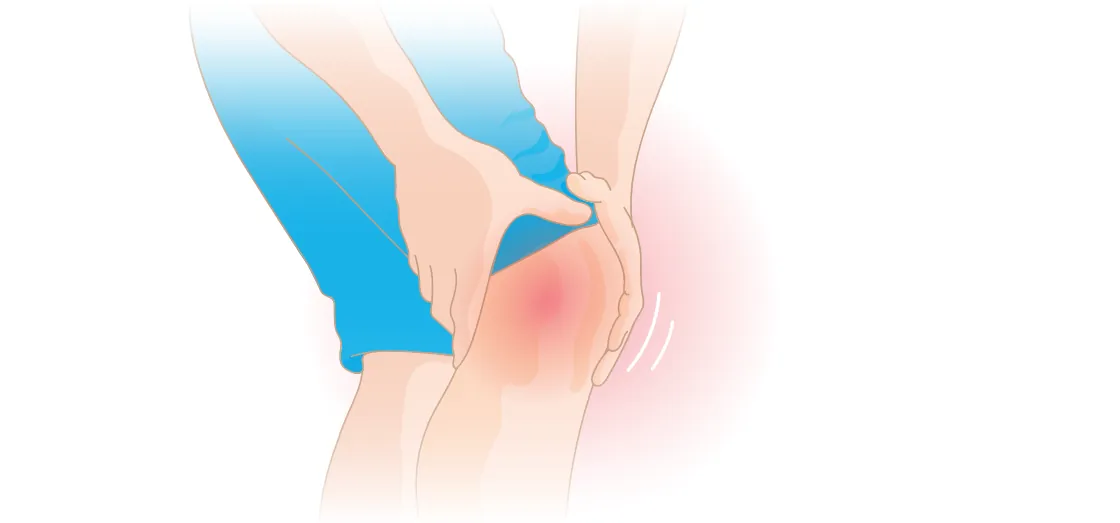
Illustration: InjuryMap via Wikimedia Commons, CC BY-SA 4.0
Stairs hurt. Getting up from a low chair hurts. Maybe it aches on the inside of the knee, maybe under the kneecap, maybe along the outside. You get it imaged, and the report says everything looks fine.
That's frustrating. But it's also a clue.
The knee is the biggest and most complex joint in your body, but its main job is simple. It bends and straightens. It isn't built to handle a lot of twisting.
The problem is that the joints above and below it can hand it twisting forces it never asked for.
When your foot rolls in too far, your shin rotates inward with it. That twist travels straight up into the knee with every step.
When your hip sits slightly out of its best position or the muscles on the side of your hip stop doing their job, the thigh drifts and the knee takes extra strain.
Tight quads, hamstrings, or the band along the outside of your thigh can pull the kneecap off its track and squeeze the joint.
An MRI is great at showing damage. Torn cartilage, a torn ligament, a worn joint surface. What it can't show is how forces are moving through your leg while you walk up the stairs.
One patient we worked with had chronic knee pain that was worse on stairs. The MRI was read as normal. Assessment found a foot that rolled in, a shin that twisted with it, thickened tissue along the outside of the thigh, and a hip that sat a little forward. The knee was absorbing force from both ends.
After the first week, treatment focused on the foot, the hip, and the outer thigh, not the knee itself. That patient's knee pain resolved within four weeks. Read more case studies.
Our approach combines massage with super pulsed cold laser, working through the whole leg instead of parking on the sore spot.
Every session starts by calming your body's stress response. A nervous system on high alert holds muscles tight no matter what we do locally.
We support circulation from the top of the leg down, so the tissues we work on next have what they need to recover.
Then we treat each sore area on the knee directly to calm the irritation.
Ankle, hamstrings, glutes, quads, and the outside of the hip all get attention. These are the muscles deciding how much strain reaches your knee.
Laser calms the tissue and helps it recover. Massage helps put your leg back into a better position. Used together, the laser supports the body in that corrected position. Your protocol is matched to your healing phase, and your starting session count comes from our Decade Rule.
If your imaging came back clean but your knee still hurts on every stair, the answer is probably above or below it. An assessment looks at the whole leg.
Book a $75 Session See Membership & Packages Ask the Organic Mechanic